Hair shape depends on different interactions within keratin. Water and heat affect temporary styling; chemical perming involves more persistent structural changes. Wash durability and damage risks differ, so a description of curled hair should specify the process used.
Disulfide bonds are important connections in keratin. Controlled reduction, shaping and oxidation alter some of these connections during perming. Insufficient processing affects retention; excessive processing reduces strength. Verify stability after washing and changes in breakage as well as curl formation.
No. Steam supplies heat and moisture; perming also requires specific chemicals and reactions. Similar supplied curls can come from different processes and behave differently after washing. Confirm persistent texture through repeated washing rather than promising it from a process name alone.
Each heat or chemical treatment adds stress, and existing damage does not disappear when the curl changes. Repeated processing makes weak regions more vulnerable. Review processing records and test a small bundle before deciding whether to reprocess or replace the material.
Describe hair as a material supported by internal connections: styling alters some connections and excessive processing weakens support. This explains the balance between softness and strength, but does not replace testing or justify claims that every material tolerates repeated bleaching and perming.
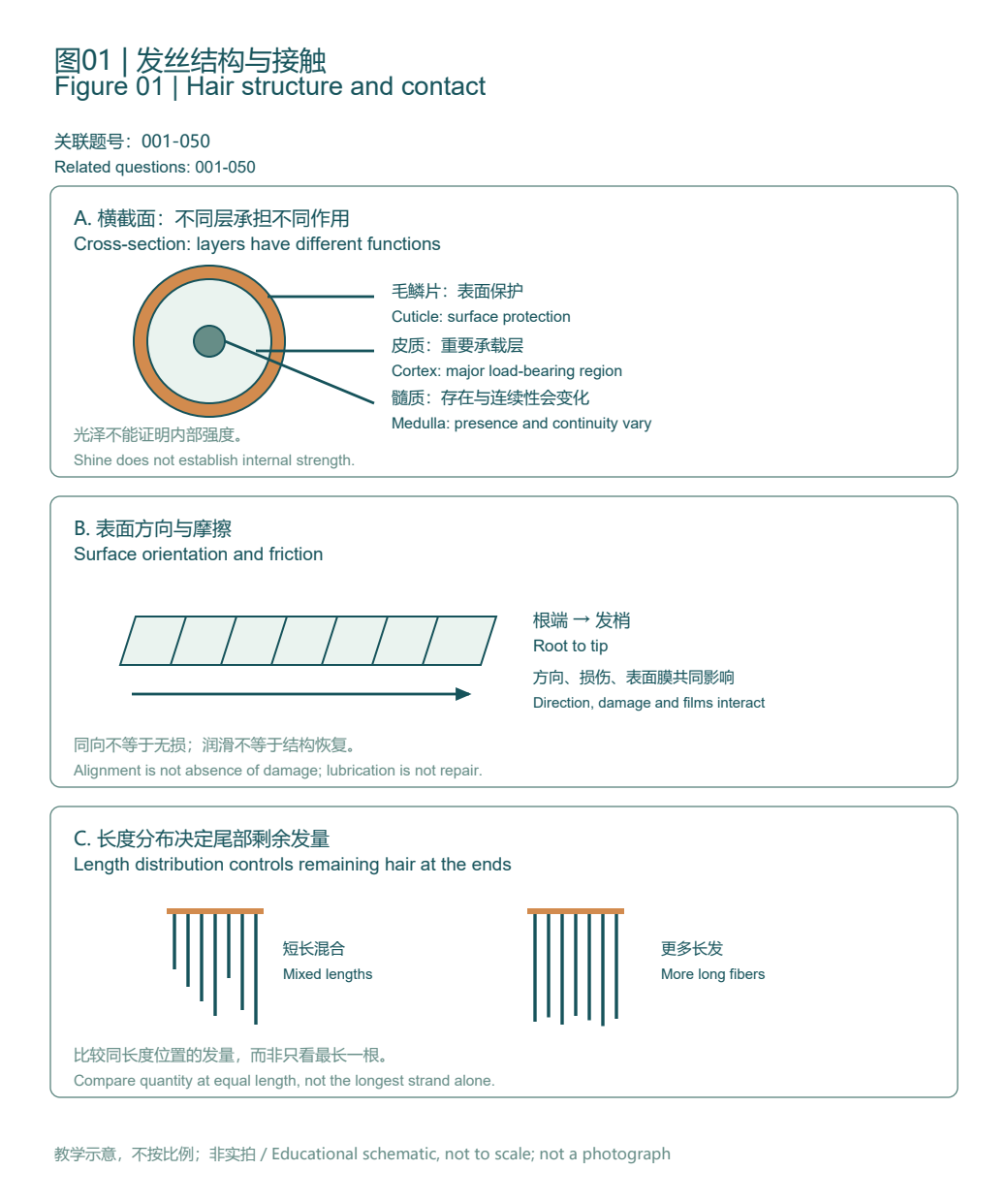
The cuticle is the overlapping outer structure of human hair, not attached dirt. Its edges and surface lubrication jointly affect friction between fibers. An intact cuticle does not guarantee freedom from tangling. Assess direction, surface damage and combing after washing together.
Cuticle orientation changes how surfaces contact during sliding. Mixed root-to-tip direction increases unfavorable contact, but conditioning films, humidity and damage also affect friction. Maintaining direction reduces one source of friction; it does not replace testing after washing.
No. A conditioning film can lower friction and temporarily mask roughness; heavily processed hair can also feel smooth. Record the supplied condition, then compare feel and combing resistance after standardized washing. Add microscopy where needed instead of relying on touch alone.
Conditioners can improve appearance and combing through lubrication and film formation, but cannot regrow detached cuticle scales. Improved smoothness and complete structural repair are different claims. Prevent damage first, then verify how long conditioning benefits persist.
Do not write only 'intact cuticle.' Specify whether cuticles are retained, whether root-to-tip direction is aligned, permitted processing and performance after washing. Microscopy describes only sampled locations. Acceptance must cover different bundles and length regions rather than one small bundle representing the batch.
The cortex plays a major mechanical role; the cuticle mainly protects the surface. Medulla presence and continuity vary. Shine does not establish internal strength. Even if dyed or bleached hair feels smooth, check breakage, elongation and performance after washing.
A larger diameter generally changes load-bearing capacity, but pre-existing defects, chemical damage and loading location also determine failure. Thick hair can still break at a localized weak point. Compare multiple fibers from the batch instead of assuming that thicker hair is always stronger.
Changes to internal proteins do not always immediately produce visible splits or abnormal color. Conditioners can also improve the feel of processed hair. Compare strength, combing and breakage before and after treatment; one enlarged photograph cannot fully assess internal condition.
Gauge length, extension speed, wet or dry state and grips affect results. Grip damage can produce falsely low values. Use the same method for supplier comparisons and distinguish grip failures from failures within the valid test section; different readings need not mean different hair quality.
Provide conditions, sample count and the distribution of results for the same batch, with comparison to the approved sample. A maximum breaking force alone is misleading because a few strong fibers do not represent a bundle. Identify manual pulling as shop-floor screening rather than instrumental data.